
The Rise of Embodied Intelligence: Amazon’s Million-Bot Milestone
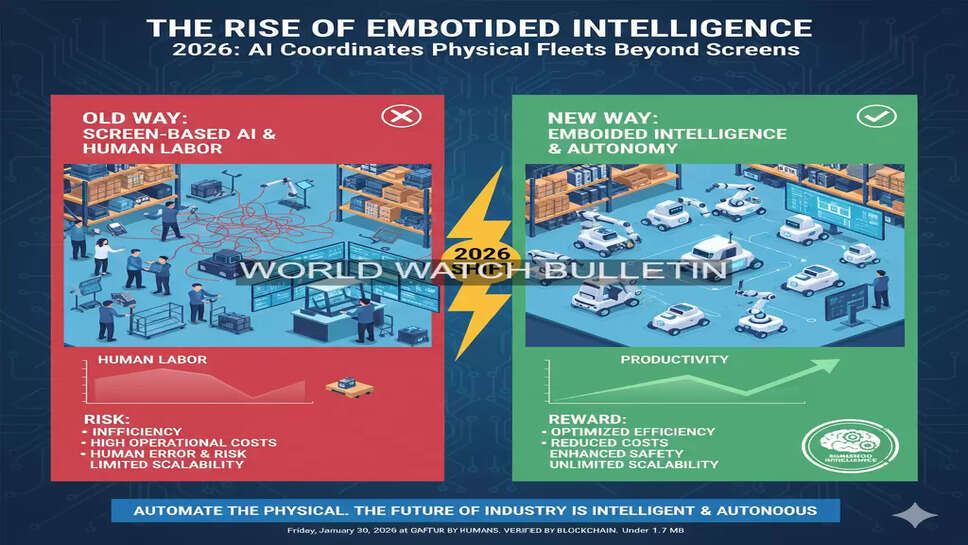
In 2026, Embodied Intelligence means that robots like Proteus (autonomous floor movers), Cardinal (sorting arms), and the tactile-sensing Vulcan now coordinate their movements in real-time without human commands. This "Intelligent Traffic Management" has reduced robot travel time by $10\%$ and eliminated the "gridlock" common in early-automated facilities. Furthermore, 2026 marks the commercial scaling of humanoid collaborators, such as Agility Robotics' Digit, which now works alongside human employees to handle the "tedious middle" of logistics—moving empty totes and managing ergonomic tasks that traditional wheeled robots cannot perform.
The 2026 "Physical AI" Tech Stack
The transition to a coordinated physical fleet relies on three 2026 technological pillars:
-
Slam-Navigation 2.0: 2026 robots no longer require floor stickers or magnetic tape. They use high-fidelity LiDAR and vision-based SLAM (Simultaneous Localization and Mapping) to navigate legacy warehouses "as-is."
-
Tactile Feedback Loops: New 2026 models like Vulcan utilize "Force Feedback" sensors, giving robots a digital sense of touch. This allows them to handle fragile items—from glassware to soft produce—with the same care as a human hand.
-
Edge-Cloud Synthesis: While 2026 robots make split-second "reflex" decisions locally (Edge AI), they are constantly fed high-level strategy from the cloud (AWS SageMaker), allowing a single fleet to self-optimize based on live order surges.
2026 Productivity Comparison: Pre-DeepFleet vs. Embodied Fleet
| Feature | Legacy Automation (Pre-2025) | Embodied Intelligence (2026) |
| Coordination | Scripted/Non-communicative. | Agentic/Peer-to-Peer Planning. |
| Object Handling | Rigid/Uniform Items only. | Tactile/Variable (Universal Gripping). |
| Deployment | Requires fixed infrastructure. | Plug-and-Play (Infrastructure-agnostic). |
| Decision Speed | Human-in-the-loop (Slow). | Autonomous Traffic Flow (Real-time). |
| Workforce Ratio | Support role. | Near 1:1 (Robot-to-Human). |
The "Collaborative Era" of late 2026
The 2026 shift is redefining the "human" role in the warehouse.
-
From Execution to Supervision: In 2026, the average warehouse role has pivoted. Workers are no longer "pickers"; they are Fleet Coordinators, using tablet interfaces to manage groups of 20–50 robots.
-
Predictive Re-Slotting: By mid-2026, DeepFleet AI predicts which products will be popular in the next hour and autonomously moves those "high-velocity" items to the front of the warehouse before the customer even clicks "buy."
-
Humanoid-as-a-Service (HaaS): In late 2026, smaller companies are following Amazon's lead, using "Robotics-as-a-Service" to lease humanoid fleets for seasonal peaks, making Embodied Intelligence accessible beyond the tech giants.
Conclusion
The 2026 rise of Embodied Intelligence signals the end of the "Screen-Only" AI era. By giving AI eyes, hands, and legs, companies like Amazon have transformed the warehouse from a storage space into a living, learning organism. As we move into 2027, this technology will likely migrate from the warehouse to the street, as the coordination logic of DeepFleet begins to power autonomous delivery vans and urban drones. In 2026, the "Ghost in the Machine" has finally stepped out into the world.
FAQs
How many robots does Amazon have in 2026?
As of early 2026, Amazon has surpassed 1.1 million robots globally, nearly equaling its total number of human warehouse employees.
What is "DeepFleet" in 2026?
DeepFleet is a Generative AI foundation model introduced in late 2025 that manages the traffic and coordination of all robots in a facility to prevent congestion.
Are these robots taking human jobs in 2026?
While hiring for manual roles has slowed, Amazon reports that its Next-Gen Fulfillment Centers require $30\%$ more employees in high-skill maintenance, engineering, and data analysis roles.
Can 2026 robots feel what they are touching?
Yes. The 2026 Vulcan model features tactile sensors that provide force feedback, allowing it to "feel" the weight and fragility of an object to avoid crushing it.
Is this only in the US in 2026?
No. The millionth robot was deployed in Japan, and Amazon’s 2026 roadmap includes major expansions of DeepFleet-enabled facilities across Europe and India.