
The Rise of "Agentic AI" Teams: The Silicon Workforce of 2026
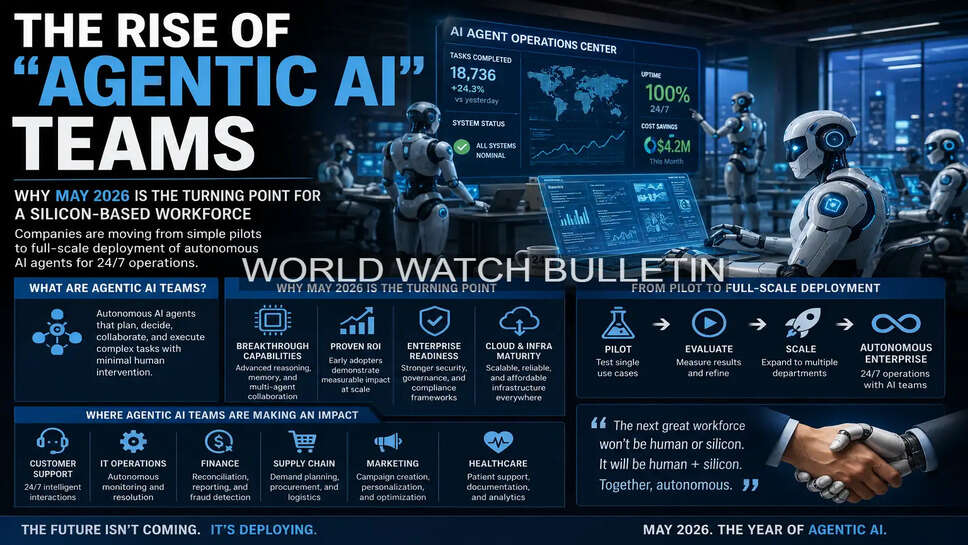
For the past two years, artificial intelligence has primarily served as a high-powered assistant—a tool that waits for a human prompt to generate an email, a line of code, or a summary. However, May 2026 has emerged as the definitive turning point for the "Agentic AI" revolution. We are witnessing a massive structural migration as enterprises move beyond simple experiments to the full-scale deployment of autonomous AI agents that don't just suggest work, but execute it.
Unlike traditional automation, which follows a rigid script, Agentic AI is goal-driven. In 2026, companies are no longer hiring "bots" for specific tasks; they are deploying "Silicon Teams" capable of planning, reasoning, and collaborating across software platforms to achieve complex business outcomes. From supply chain orchestration to 24/7 cybersecurity remediation, the 2026 workforce is becoming a hybrid of human strategic oversight and autonomous machine execution.
The Shift: From Assistants to Agents
The transition in May 2026 is defined by three core technological pillars:
-
Multi-Agent Systems (MAS): Instead of one AI doing everything, 2026 deployments feature "Swarms" of specialized agents. One agent might handle customer intake, another checks real-time inventory, and a third processes the payment—all communicating with each other in milliseconds to resolve a request end-to-end.
-
Recursive Planning: These agents can now break down a broad objective (e.g., "Optimize our May logistics for the Strait of Hormuz crisis") into hundreds of sub-tasks, adjusting their plan in real-time as new data arrives.
-
Hardware-Locked Memory: To ensure security, 2026 enterprises are running these agents on "Sovereign AI" infrastructure—hardware-locked environments where the agent's "memory" of sensitive company data never leaves the private server.
The 2026 Workforce Transformation
| Metric | The Pilot Era (2024-2025) | The Agentic Era (May 2026) |
| Operational Hours | Human-led (8/5 or 24/7 with shifts). | Autonomous 24/7 Operations. |
| Interaction Style | Prompt-and-Response. | Goal-and-Execution (Proactive). |
| Software Use | Humans use tools via UI. | Agents use tools via APIs & CLIs. |
| Success Metric | Productivity Per Hour. | Outcome Completion Rate. |
| Labor Structure | Human + Copilot. | Human + Autonomous AI Teams. |
Industry Impact: Real-World 2026 Deployments
In May 2026, the "Agentic Workforce" is already reshaping key sectors:
-
IT & Cybersecurity: Cisco and other leaders have unveiled "Agentic Security Frameworks" where autonomous agents identify, isolate, and patch vulnerabilities at "machine speed" before a human analyst even receives the alert.
-
Customer Experience (CX): We have moved beyond the "frustrating chatbot." 2026 agents have full access to customer history and backend systems, allowing them to issue refunds, rebook travel, or troubleshoot complex technical issues without human intervention.
-
Software Development: Anthropic and GitHub reports indicate that in May 2026, over 40% of enterprise code is being authored, tested, and deployed by autonomous "Coding Agents," with humans shifting into the role of high-level "System Architects."
Conclusion
The Rise of Agentic AI Teams is not just a tech trend; it is a fundamental reimagining of what "work" looks like. In 2026, the competitive advantage belongs to firms that can effectively manage a silicon-based workforce. As we transition from "AI as a tool" to "AI as a teammate," the goal is no longer to do more with less—it's to achieve outcomes that were previously impossible. The 24/7, autonomous enterprise has arrived, and it's powered by agents that never sleep, never tire, and never stop optimizing.
FAQs
What is the difference between Generative AI and Agentic AI?
Generative AI responds to prompts (e.g., writing a poem). Agentic AI is given a goal (e.g., "Increase sales by 5%") and autonomously decides which tools to use and which actions to take to achieve it.
Are AI agents replacing human jobs in 2026?
They are transforming them. While repetitive middle-management and entry-level tasks are being automated, new roles are emerging for "Agent Orchestrators" and "AI Governors" who oversee these silicon teams.
What is a "Multi-Agent System"?
It is a network of specialized AI agents that work together. Just like a human marketing team has a writer, a designer, and a strategist, a Multi-Agent System has different AI models collaborating to finish a project.
Is my data safe with autonomous agents?
In 2026, most enterprises use "Sovereign AI" or "Confidential Computing," which keeps the agent's work and the company's data locked inside private, encrypted hardware environments.
Can Agentic AI work 24/7?
Yes. Because they don't suffer from fatigue or "context rot," these agents can monitor systems, handle customers, and manage supply chains around the clock without any drop in performance.
What industries are seeing the biggest shift in May 2026?
IT operations, finance, customer support, and software development are currently the leaders in full-scale agentic deployment.