
Quantum-Safe Networking: Why US Government Agencies are Mandating Post-Quantum Cryptography for 2026 Infrastructure
As of January 2026, the United States has officially entered the "Transition Era" for cybersecurity. Following the finalization of NIST’s post-quantum standards in late 2024, federal agencies are now operating under strict 2026 mandates to overhaul their networking infrastructure. This shift to Post-Quantum Cryptography (PQC)is no longer a theoretical exercise—it is a mandatory response to the "Harvest Now, Decrypt Later" threat, ensuring that the nation's most sensitive data remains secure against the looming power of cryptographically relevant quantum computers (CRQCs).
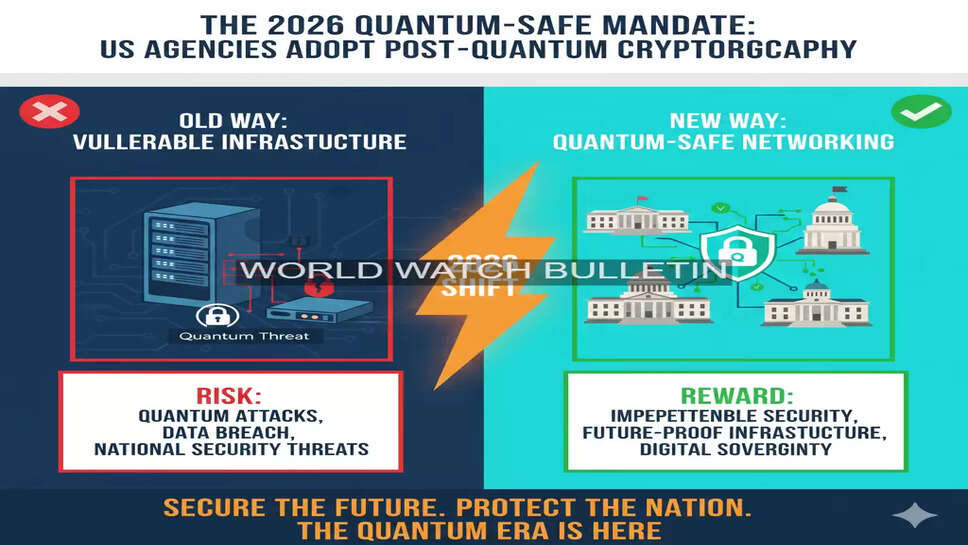
The 2026 Mandate: From Planning to Implementation
The move toward quantum-safe networking is driven by a series of high-level directives that have reached critical deadlines in early 2026.2 The Quantum Computing Cybersecurity Preparedness Act and National Security Memorandum 10 (NSM-10) have converged to create a clear compliance roadmap for all federal civilian and national security systems.
-
The April 2026 Deadline: Federal agencies are required to submit their finalized, prioritized PQC Migration Plans by April 2026. These plans must move beyond simple inventories to detail specific timelines for "rip-and-replace" or "hybrid" upgrades of vulnerable systems.
-
Mandatory Procurement: As of January 2026, all new federal solicitations for IT products must include requirements for PQC support. Agencies are now legally barred from procuring long-term infrastructure that relies solely on quantum-vulnerable algorithms like RSA or ECC.
-
Hybrid-First Architecture: Because pure PQC deployments are still maturing, the 2026 standard is Hybrid Cryptography.3 This approach wraps traditional encryption with a quantum-resistant layer (such as ML-KEM), providing immediate protection without breaking compatibility with legacy systems.4
Why the Urgency? The "Harvest Now, Decrypt Later" Threat5
The primary driver for the 2026 mandate is a phenomenon known as SNDL (Store Now, Decrypt Later). Adversaries are currently intercepting and archiving encrypted government and military communications, betting that quantum computers in the 2030s will allow them to unlock today’s secrets.6
| Vulnerable Classic Algorithm | Quantum-Safe Replacement (NIST 2026) | Primary Use Case |
| RSA / Diffie-Hellman | ML-KEM (FIPS 203) | General Encryption & Key Exchange |
| ECDSA | ML-DSA (FIPS 204) | Digital Signatures & Identity |
| EdDSA | SLH-DSA (FIPS 205) | Backup Stateless Signatures |
The Pillars of Quantum-Safe Infrastructure
Longevity and infrastructure leaders are focusing on three core areas to meet the 2026 requirements:
1. Cryptographic Discovery & Inventory
Agencies have spent the last 18 months using automated tools to map every instance of encryption across their networks. In 2026, this "Crypto-Inventory" is being integrated into real-time dashboards to identify "weak links" in the supply chain.
2. Hardware-Based Roots of Trust
Software alone is not enough. 2026 infrastructure projects are mandating the use of Hardware Security Modules (HSMs) and secure enclaves that are "Quantum-Safe-by-Design," ensuring that the keys themselves are generated and stored using quantum-resistant entropy.
3. Network "Agility"
The 2026 mandate emphasizes Crypto-Agility—the ability to swap out cryptographic algorithms without re-architecting the entire network.7 This ensures that if a specific PQC algorithm is found to have a flaw in 2027, the agency can update its defense via a firmware patch rather than a physical overhaul.
Conclusion
2026 marks the year that "Quantum-Safe" transitioned from a buzzword to a budgetary requirement. By mandating PQC for all new infrastructure, the U.S. government is attempting to close the window of vulnerability that has existed since the dawn of the internet. While the full transition to a quantum-resilient nation will take another decade, the 2026 mandates ensure that the foundations of our future digital economy—from the power grid to the Treasury—are no longer being built on shifting sand.
FAQs
What is Post-Quantum Cryptography (PQC)?
PQC refers to new mathematical algorithms designed to be secure against both classical and quantum computers.8 Unlike "Quantum Key Distribution," PQC runs on existing fiber and hardware.
Does my business need to follow these 2026 mandates?
While the mandates currently target federal agencies and their contractors, they are widely expected to become the "de facto" standard for the financial, healthcare, and energy sectors by late 2026.
Will PQC make my network slower?
Post-quantum algorithms generally have larger key sizes and require more processing power. However, 2026-era hardware acceleration is largely neutralizing this latency for most users.
What is "ML-KEM"?
Formerly known as Kyber, ML-KEM is the primary NIST-standardized algorithm for key encapsulation.9 It is the core "shield" being deployed in federal 401(k) and treasury networks this year.
Is RSA still safe to use in 2026?
For short-term data (like a 2026 credit card transaction), RSA is still secure. For data that needs to remain secret for 10+ years (like medical or national security records), it is considered "at risk" due to the SNDL threat.