
Neuromorphic Edge Computing: Why 2026 Smartphone Manufacturers are Ditching Traditional Chips for Brain-Inspired Hardware.
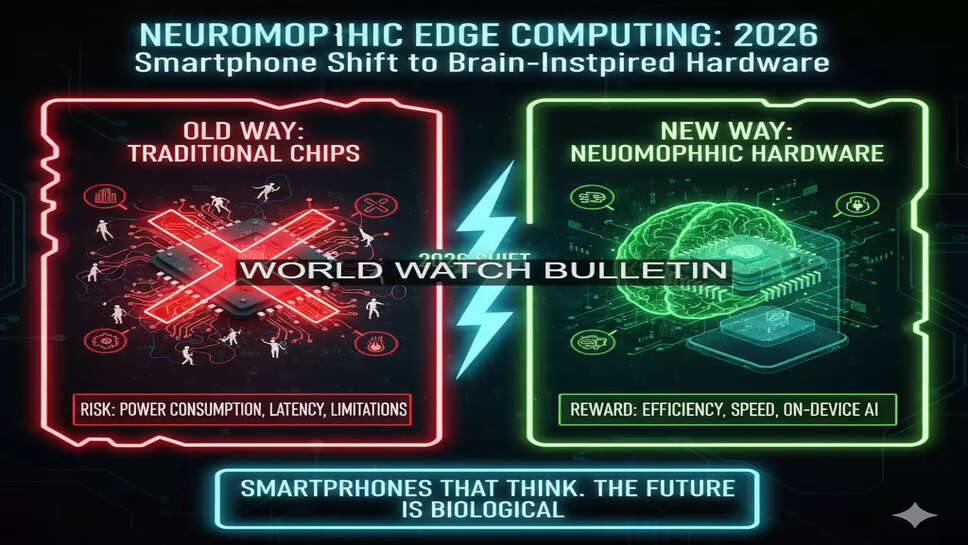
By early 2026, the "Sovereign AI" movement has moved from the cloud to your pocket. For years, the von Neumann Bottleneck—the physical distance and energy cost of moving data between memory and the processor—was the hidden tax on every mobile interaction.2 In 2026, leading manufacturers like Samsung, Apple (with the A20 Pro), and Qualcomm (Snapdragon 8 Elite Gen 5) have integrated neuromorphic cores to handle the "sparse" tasks that define modern life: always-on voice assistants, gaze tracking, and real-time health monitoring.3 These chips operate on milliwatts rather than watts, allowing 2026 phones to perform complex AI tasks for days on a single charge.4
The Architecture Shift: Neurons vs. Logic Gates
The core reason for the switch is Event-Driven Processing.5 Traditional processors are "Always-On," consuming power even when waiting for an input.6 Neuromorphic chips, however, utilize In-Memory Computing, where the processing happens where the data is stored.7
| Feature | Traditional CPU/GPU (2024) | Neuromorphic Processor (2026) |
| Architecture | von Neumann (Separate Memory/Compute) | Brain-Inspired (Integrated Memory/Compute) |
| Data Flow | Synchronous (Global Clock-Driven) | Asynchronous (Event-Driven Spikes) |
| Energy State | High Idle Drain | Near-Zero Idle Drain |
| Best For | Dense Matrix Math (High-Throughput) | Sparse, Real-Time Sensing (Edge Intelligence) |
Why 2026 is the "Neuromorphic Year"
Three critical technological convergences made this ditching of traditional silicon possible:
-
The Rise of Spiking Neural Networks (SNNs): Unlike the continuous mathematical layers of ChatGPT, SNNs communicate through discrete "spikes" of electricity.8 This allows for Temporal Encoding, where information is stored in the timing of the signals, drastically reducing the bits of data needed to recognize a face or a voice.9
-
Hybrid Silicon: 2026 phones don't use only neuromorphic chips. They use a "Multi-Brain" approach. A traditional ARM-based CPU handles the OS, a GPU handles gaming, and the Neuromorphic NPU (Neural Processing Unit) manages the 24/7 background intelligence.
-
Sensor Fusion: New "Event-Based Cameras" (inspired by the human retina) only send data when a pixel changes its brightness.10 Combined with a neuromorphic chip, a 2026 phone can detect motion or a gesture in under 5 milliseconds while consuming 90% less power than a standard camera sensor.
Real-World Impact: The 2026 User Experience
For the retail consumer in 2026, the benefits of "Brain-Inspired" hardware are felt in three specific areas:
-
"Calm" Intelligence: Your phone understands context (like being in a meeting or a theater) and adjusts notifications purely through on-device sensor analysis, without needing to ping the cloud.
-
Biometric Autonomy: Advanced health wearables and smartphone sensors now perform Real-Time ECG and glucose pattern analysis locally.11 Because the chip "learns" your specific baseline, it only alerts you when it detects a "spike" in an irregular pattern.
-
Privacy by Design: Because neuromorphic chips are so efficient, they can run large-scale privacy filters on every bit of data before it ever reaches the operating system or an app, effectively creating a "hardware firewall" for your personal life.12
Conclusion
The transition to neuromorphic edge computing in 2026 marks the end of the "Brute Force" era of mobile technology. By mimicking the efficiency of the human brain—which operates on roughly 20 watts of power—smartphone manufacturers have found a way to deliver "Hyper-Intelligence" without tethering users to a wall charger.13 As we move deeper into 2026, the success of these brain-inspired chips is paving the way for the next frontier: autonomous robotics and vehicles that think, react, and learn exactly like we do.14
FAQs
Does a neuromorphic chip make my phone faster?
In terms of "reaction time" (latency) for tasks like face ID or voice recognition, yes.15 However, traditional CPUs are still better for tasks like rendering high-end video or complex spreadsheets.
How does "In-Memory Computing" save battery?
In traditional phones, moving data between the RAM and the CPU accounts for up to 80% of energy use. Neuromorphic chips eliminate this "shuttling" by performing calculations directly within the memory cells.16
Will my current apps work on neuromorphic hardware?
Yes. In 2026, mobile OS layers (Android 16 and iOS 19) automatically offload specific background and AI tasks to the neuromorphic core, while standard app logic stays on the CPU.
What is an "Event-Based Camera"?
It’s a camera inspired by the retina that only records changes in a scene.17 If nothing moves, no data is sent. This is perfectly paired with neuromorphic chips for ultra-low-power surveillance and gesture control.
Is this technology used in 2026 foldables?
Extensively. 2026 foldables use neuromorphic sensors to detect the exact angle of the screen and the user’s hand position to adapt the interface instantly with zero lag.