
The "Annihilation" Decree: Pope Leo XIV’s Moral Stand Against AI Warfare
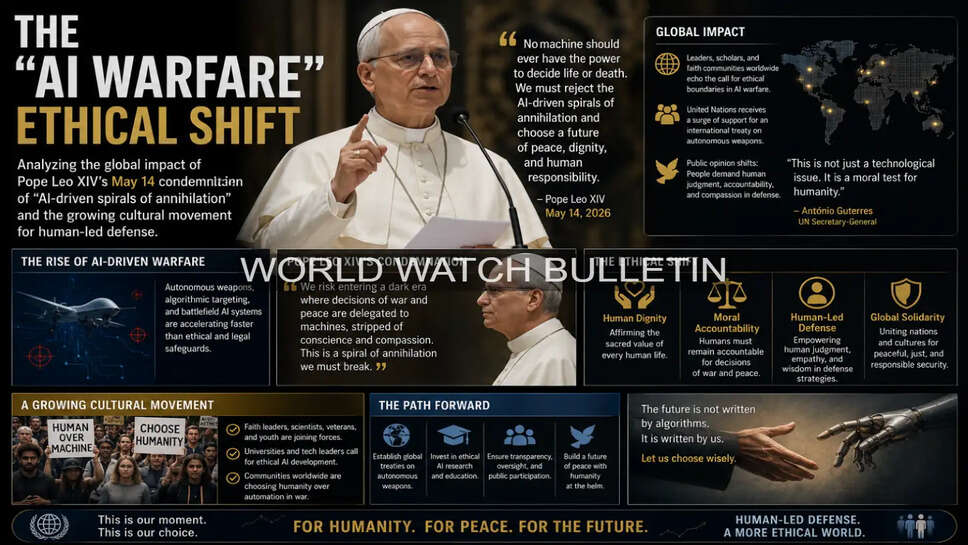
The moral landscape of modern conflict underwent a profound shift. Speaking at Rome’s Sapienza University, Pope Leo XIV—the first American pontiff—delivered a blistering denunciation of the "inhuman evolution" of war. He warned that the world is being sucked into a "spiral of annihilation" as artificial intelligence and autonomous weaponry increasingly replace human judgment on the battlefield.
This was not just a theological plea for peace; it was a strategic intervention. Coming at a time when Ukraine has successfully deployed all-robot units and the U.S. Pentagon is moving toward "Steel for Blood" doctrines, the Pope’s message challenged the very core of 21st-century military strategy. By framing AI warfare as a moral betrayal that "absolves humans of responsibility," Leo XIV has galvanized a growing cultural movement demanding a return to Human-Led Defense.
The "Annihilation" Speech: Key Pillars
The Pope’s address targeted the rapid "technological absorption" of warfare, specifically citing active conflicts in Ukraine, Gaza, Lebanon, and Iran.
-
The Responsibility Gap: Leo XIV argued that delegating life-and-death decisions to algorithms removes the "sacred weight" of human choice, making the escalation of violence easier and more detached.
-
The Economic Betrayal: He decried the "trillions" being diverted into high-tech rearmament at the expense of education and healthcare, labeling current military spending a "betrayal of diplomacy."
-
The Anthropological Challenge: The Pontiff warned that AI is not just changing how we fight, but who we are, replacing real-world relationships with "simulated realities" that fuel polarization and fear.
Global Reaction: A Fractured Response
The impact of the May 14 decree has been immediate and polarizing, reflecting the deep tensions between the Vatican and world leaders.
| Entity | Official Reaction / Action |
| The Pentagon (US) | Reaffirmed "Human-in-the-loop" policies but continued a $52M "Steel for Blood" drone contract. |
| President Trump | Maintained "America First" rearmament goals, leading to a public "tussle" with the Pontiff over the Iran war. |
| European Union | Increased calls for "AI Sovereignty" and ethical guardrails in military AI development. |
| Human Rights Orgs | Launched the "Magnifica Humanitas" campaign to ban lethal autonomous weapons (LAWS). |
| Ukraine (Zelensky) | Defended AI use as a "life-saving" necessity for warriors in high-danger zones. |
The "New Humanism" Movement
Beyond the halls of power, Leo XIV’s words have sparked a "New Humanism" movement among the youth. In his Africa tour earlier this year and again at Sapienza, he urged students to be "artisans of true peace" who look beyond national borders and digital screens.
This cultural shift is manifesting in a rejection of "reckless accelerationalism." From university walkouts protesting military AI research to a surge in demand for "embodied experiences" (like hand-writing, contemplation, and in-person worship), a generation is beginning to push back. The Pope’s upcoming encyclical, Magnifica Humanitas, is expected to formalize this stance, arguing that technological progress must remain subordinate to human dignity.
Conclusion
The "AI Warfare" Ethical Shift of May 2026 is a reminder that just because we can automate the battlefield doesn't mean we should. Pope Leo XIV has used the "Bully Pulpit" of the papacy to remind a high-tech world of its low-tech soul. As military AI continues to evolve toward a "spiral of annihilation," the call for a human-led defense is no longer just a pacifist dream—it is becoming a vital prerequisite for human survival in a silicon age.
FAQs
What did Pope Leo XIV say on May 14, 2026?
He condemned the use of AI in warfare, stating that it leads to an "inhuman evolution" and a "spiral of annihilation" by removing human responsibility from the act of killing.
What is the "Spiral of Annihilation"?
The Pope used this term to describe how investments in high-tech weaponry and AI-driven conflict create a self-sustaining cycle of escalating violence and dehumanization.
How has the U.S. responded?
While Secretary of State Marco Rubio sought to smooth over tensions, the administration continues to invest heavily in AI, framing it as a way to save human lives by "trading steel for blood."
What is "Magnifica Humanitas"?
It is the title of the Pope's expected first encyclical, which will provide comprehensive moral guidance on AI, human dignity, and the "New Humanism."
Is there a movement to ban AI weapons?
Yes. Following the Pope's speech, there has been a significant surge in global advocacy for a ban on "Lethal Autonomous Weapons Systems" (LAWS), also known as "killer robots."
Why is this called an "Ethical Shift"?
Because for the first time, a global moral authority has framed AI development not as a technical milestone, but as an existential threat to our human identity and moral accountability.