
The "TradFi-DeFi" Convergence: 2026’s Invisible Banking Revolution
In 2026, the wall between traditional and decentralized finance has crumbled as banks integrate blockchain rails for real-time settlements and "invisible" collateral.
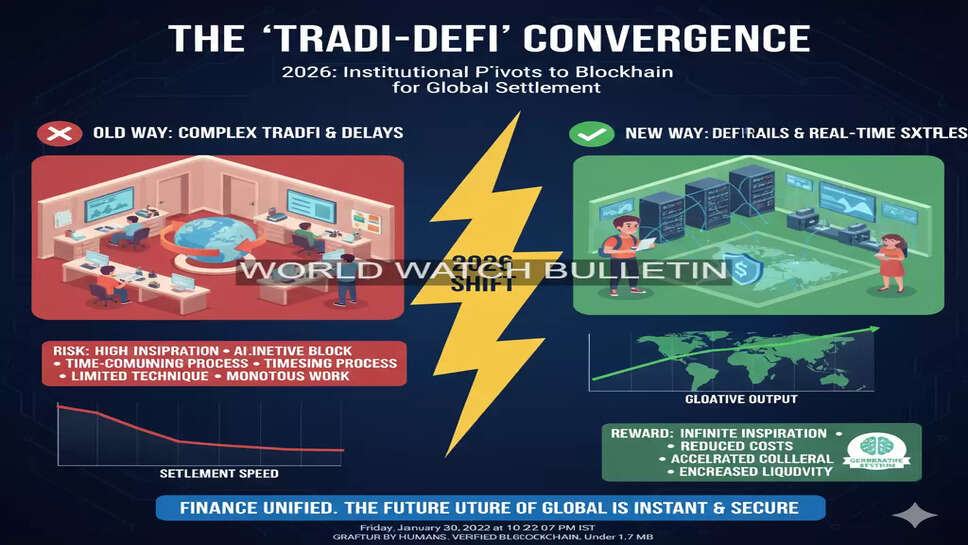
The financial world has entered the era of the "TradFi-DeFi" Convergence. The experimental phase of blockchain is over; 2026 is defined by the integration of decentralized protocols directly into the "plumbing" of global banking. Following the landmark passage of the U.S. GENIUS Act in late 2025 and the full implementation of Europe’s MiCA framework, major institutions like JPMorgan Chase, Goldman Sachs, and Citigroup have moved from pilots to production. These banks are now using blockchain rails not as a speculative asset class, but as an Operating Layer for invisible collateral management and real-time cross-border stablecoin settlements that bypass the multi-day delays of the legacy SWIFT system.
The 2026 breakthrough is the rise of "Invisible Collateral." Using tokenized Real-World Assets (RWAs), banks can now mobilize traditionally "trapped" capital—such as commercial real estate, private equity, or T-bills—and use them as instant collateral on-chain. In 2026, a bank can execute a repo transaction (repurchase agreement) in seconds rather than days, with the collateral moving "invisibly" via smart contracts. This has created a massive surge in capital efficiency; by mid-2026, the market for tokenized U.S. Treasuries alone has surpassed $50 billion, providing a stable, yield-bearing foundation for the new digital economy.
The 2026 Institutional Rails
The "TradFi-DeFi" merger is powered by three core 2026 infrastructure shifts:
-
Real-Time Stablecoin Settlement: In 2026, B2B cross-border payments have transitioned to regulated stablecoins (like USDC or bank-backed Euro-tokens). Transactions that once took 3–5 days now settle in under 3 minutes for a fraction of the cost.
-
Permissioned DeFi Pools: Institutional giants are no longer "trading in the wild." They utilize platforms like Aave V4’s isolated, KYC-compliant pools, allowing them to tap into decentralized liquidity while remaining $100\%$ compliant with global AML laws.
-
Unified Ledger Interoperability: By early 2026, the "Fragmentation Crisis" was solved by interoperability protocols that allow a private bank chain (like JPM Coin) to communicate seamlessly with public networks like Ethereum or Polygon.
2026 Finance Comparison: Legacy Banking vs. Blockchain-Integrated Banking
| Feature | Legacy TradFi (Pre-2025) | Integrated TradFi-DeFi (2026) |
| Settlement Time | T+2 (Stocks) / 3-5 Days (Wires). | Instant / <15 Minutes (Atomic). |
| Collateral Mobility | Slow / Manually intensive. | "Invisible" / Programmable (Real-time). |
| Operating Hours | 9-to-5 / Closed on Weekends. | $24/7/365$ (Always-on). |
| Cost Basis | High Intermediary Fees. | Low Protocol-Based Fees. |
| Asset Type | Physical/Account-based. | Tokenized / Smart Contract-based. |
The "Programmable Money" Economy of Late 2026
The 2026 convergence has turned money into an "Internet Protocol."
-
Autonomous Corporate Treasury: By late 2026, Fortune 100 companies have begun using AI agents to autonomously move stablecoin balances between yield-bearing DeFi protocols to optimize their "idle cash" overnight.
-
The Death of Pre-Funding: In 2026, banks no longer need to keep billions in "nostro/vostro" accounts across the globe to facilitate payments. They use Just-in-Time (JIT) Liquidity powered by stablecoins, freeing up massive amounts of capital.
-
Institutional M&A: 2026 has seen a record number of "Cross-Over Acquisitions," where traditional payment processors (like Visa) are acquiring crypto-infrastructure firms to secure their own private blockchain rails.
Conclusion
The 2026 "TradFi-DeFi" Convergence marks the moment blockchain became boring—and therefore, universal. By moving the world’s $500 trillion financial system onto transparent, programmable rails, banks have unlocked a level of speed and security that was unthinkable a decade ago. In 2026, you don't "use a blockchain"; you just use a bank that is finally as fast as the internet. As we move into 2027, the focus will shift from how the money moves to what we can build now that money is truly programmable.
FAQs
Is my money safe if banks use DeFi in 2026?
Yes. In 2026, banks use "Permissioned Enclaves" and audited smart contracts. They are not using the "wild west" version of DeFi, but rather regulated "Institutional DeFi" layers that have bank-grade security.
Why did this take until 2026?
It required the 2025 Regulatory Wave (the GENIUS Act and MiCA) to give banks the legal "green light" to hold digital assets on their balance sheets and use them for settlement.
Does this replace the U.S. Dollar in 2026?
No. In 2026, the U.S. Dollar is actually strengthened by this trend, as the vast majority of global stablecoins and tokenized Treasuries are denominated in USD.
Can I see these blockchain transactions in 2026?
While the underlying rails are blockchain-based, the experience for the average customer is "invisible." Your bank app will look the same, but your international transfers will simply arrive in seconds instead of days.
What is "Atomic Settlement" in 2026?
It means the exchange of the asset and the payment happens simultaneously. In 2026, there is no "settlement risk" because the asset doesn't move unless the payment is verified by the blockchain in the same instant.