
CBDC Privacy Shields: The 2026 Digital Dollar Protocols Designed to Protect Individual Transaction Anonymity
As of early 2026, the debate over a U.S. Central Bank Digital Currency (CBDC) has reached a critical turning point. Following the Executive Order of January 23, 2025, which prohibited the federal issuance of a direct-to-consumer CBDC, the focus has shifted toward "Privacy-First" infrastructure. In 2026, the U.S. is piloting "Privacy Shields"—cryptographic layers that allow the Federal Reserve to issue a digital dollar while ensuring it cannot "see" or track individual transactions. These protoco
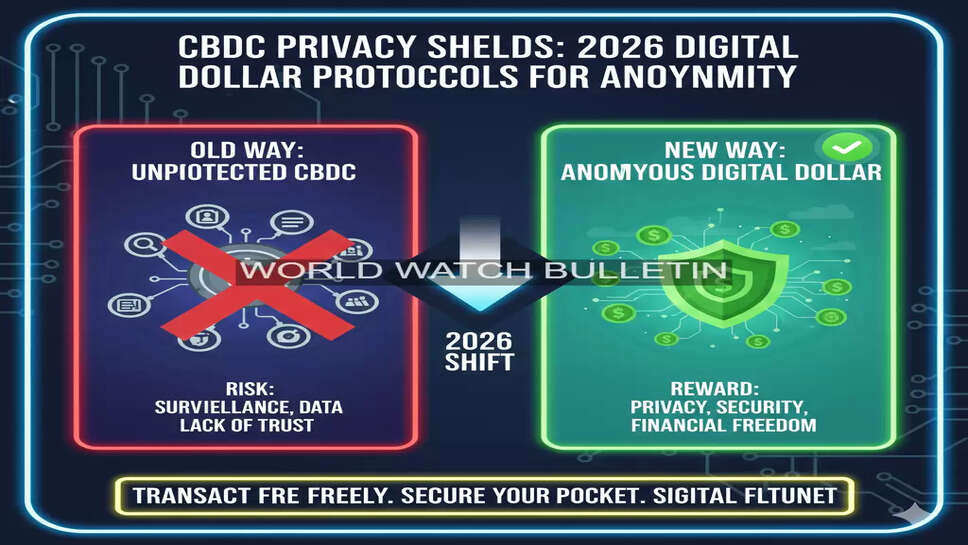
The primary challenge for a 2026 digital dollar is the "Privacy-Compliance Paradox": how to allow citizens to spend money anonymously while preventing bad actors from laundering billions. The solution appearing in 2026 is a tiered "Privacy Shield" architecture. This system moves away from the "Transparent Ledger" model of early cryptocurrencies like Bitcoin and toward a Privacy-by-Design framework where transaction details are shielded from the central bank, commercial banks, and even the merchants themselves for low-value daily purchases.
The Three Pillars of 2026 Privacy Shields
-
Zero-Knowledge Proofs (zk-SNARKs): In 2026, the U.S. "Digital Dollar" prototypes utilize zk-SNARKs to verify that a transaction is valid (e.g., the sender has the funds and hasn't already spent them) without revealing the sender’s identity, the recipient’s address, or the specific amount. This allows the Federal Reserve to maintain the integrity of the money supply without maintaining a surveillance database of citizen behavior.
-
Quantum-Safe Blind Signatures: Inspired by Project Tourbillon (a BIS initiative), 2026 protocols use "Blind Signatures." This technique allows the central bank to "sign" a digital banknote to prove it is authentic without knowing the unique serial number or the identity of the person holding it. By 2026, these signatures have been upgraded to be "Quantum-Safe" to protect against future decryption threats.
-
Tiered Anonymity Thresholds: The 2026 "Privacy Shield" is not an all-or-nothing system.
-
Tier 1 (Cash-Like): Transactions under $1,000 are fully anonymous and leave no trackable digital footprint on central servers.
-
Tier 2 (Account-Based): Larger transactions require a "Privacy Key" held by a neutral third-party ombudsman, which can only be revealed under a court-ordered warrant for suspected criminal activity.
-
The Legislative Context: Anti-Surveillance Act 2025-2026
The implementation of these privacy shields is a direct response to the Anti-CBDC Surveillance State Act (H.R. 1919), which passed the House in mid-2025. This act explicitly prohibits the Federal Reserve from:
-
Offering accounts directly to individuals.
-
Using a CBDC for "Social Engineering" or political censorship.
-
Accessing granular transaction data without due process.
[Image: A diagram of the "2026 Privacy Shield" showing a consumer transaction. The "Identity Data" is stripped at the local wallet level, leaving only a "Mathematical Proof" (ZKP) to be sent to the Fed’s verification rail.]
Comparison: 2026 Digital Dollar vs. 2024 Stablecoins
| Feature | Standard Stablecoin (2024) | Shielded Digital Dollar (2026) |
| Privacy Model | Pseudonymous (Trackable on Explorer) | Fully Anonymous (for Tier 1) |
| Verification | Public Ledger History | Zero-Knowledge Proofs |
| Data Custody | Private Corp / Public Ledger | No Centralized Transaction Log |
| Regulatory Link | KYC/AML at every step | "Compliance-at-the-Edge" |
Conclusion: Restoring the "Digital Right to Cash"
As the U.S. enters late 2026, the "Privacy Shield" is seen as the only way to make a digital dollar politically and socially viable. By embedding mathematical anonymity directly into the code, the 2026 protocols aim to restore the "Digital Right to Cash"—the ability for individuals to participate in the economy without their every coffee purchase being logged in a government or corporate database. While the "Digital Dollar Divide" remains a hot topic for the 2026 elections, the technology itself has proven that privacy and sovereign money can coexist.
FAQs
Can the government "turn off" my 2026 digital dollar?
Under the Anti-CBDC Act of 2025, the government is prohibited from using a CBDC to censor or block lawful transactions. The "Privacy Shield" further prevents this by ensuring the government doesn't know which "digital notes" belong to you.
How is this different from using a credit card?
Credit cards are highly trackable; banks see exactly where you shop. A 2026 digital dollar with "Privacy Shields" behaves like physical cash—the issuer knows how much money is in circulation, but not who is spending it at any given moment.
What is a Zero-Knowledge Proof (ZKP)?
It is a mathematical method that allows you to prove you have enough money for a purchase without showing your bank balance or identity.
What happens if I lose my 2026 "Privacy Key"?
For anonymous Tier 1 funds, they are like physical cash; if you lose your private key, the funds are gone. For larger, Tier 2 amounts, most 2026 wallets offer a "Social Recovery" feature to regain access through trusted contacts.
Is the digital dollar already live?
In 2026, the U.S. is primarily using Private Stablecoins governed by the CLARITY Act, while the Federal Reserve is only in the "Technical Pilot" phase for a shielded public version.