
Likeness Rights 2.0: How 2026 Actors are Using Blockchain to License Digital Twins for AI-Generated Cinema
By January 2026, the traditional "Likeness Rights" of Hollywood stars have undergone a revolutionary upgrade. Following the landmark SAG-AFTRA 2026 TV/Theatrical Agreement, which established strict guardrails for digital replicas, actors are no longer just signing away their image; they are tokenizing it. Likeness Rights 2.0 uses blockchain technology to create a "Chain-of-Title" for an actor’s digital twin. This allows stars to license their high-fidelity 8K digital replicas for stunts, younger
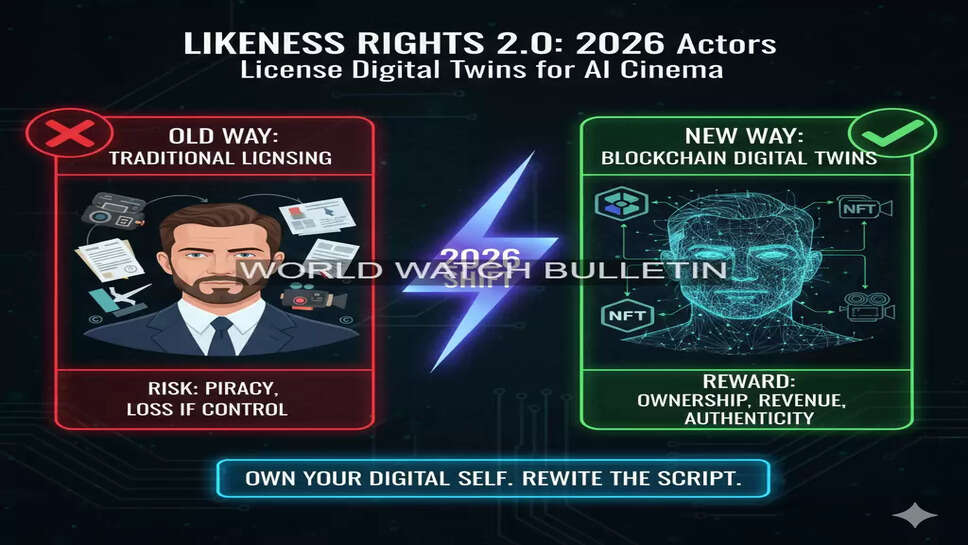
In 2026, the film industry's greatest asset is no longer just the physical presence of an actor, but their Authorized Digital Twin. As production costs for traditional shoots skyrocket, studios are turning to "Authorized AI" to populate digital volumes and LED stages.1 To prevent the unauthorized "scraping" of talent that plagued the early 2020s, the Likeness Rights 2.0 protocol has emerged. Built on enterprise-grade blockchains like Hyperledger Besu and Ethereum, this system treats an actor's digital data—their voice, movement patterns, and facial geometry—as a programmable asset that only "activates" once a licensing fee is paid.
The Mechanics of Blockchain Licensing
The 2026 licensing model moves away from flat-fee buyouts toward Granular Usage Tracking. Actors now deposit their 3D scans and voice models into Sovereign Talent Vaults.
-
Smart Contract Execution: When a studio wants to use an actor’s digital twin for a dangerous stunt or a background shot, a smart contract is triggered. The AI model only receives the "decryption key" for the actor's likeness once the studio's wallet confirms payment.
-
Micro-Royalty Payouts: If an AI-generated scene featuring a digital twin is used in a viral marketing campaign or a "Director’s Cut," blockchain ledgers track the viewership data. Micro-royalties are then distributed instantly to the actor, their agent, and the union's pension fund, bypassing the months of waiting traditionally associated with residuals.
-
Consent at the Frame Level: Under 2026 protocols, an actor can program "Forbidden Contexts" into their blockchain license—such as prohibiting their likeness from being used in political or adult content—ensuring the AI cannot render their twin in those scenarios.
[Image: A digital "Talent Vault" interface showing an actor's 3D model with "Licensed," "Pending," and "Restricted" usage tags, linked to a blockchain transaction ledger.]
De-Risking Production with "Authorized AI"
The 2026 shift is driven as much by legal necessity as it is by technology. After the Anthropic and Disney/OpenAI settlements of 2025, studios face massive "EBITDA liabilities" if they use unauthorized data.2
-
Chain-of-Title Security: Using blockchain-verified digital twins protects a project's "Chain-of-Title."3 This ensures that when a film is sold to a streamer like Netflix or Apple TV+, the distributor has ironclad, immutable proof that every pixel of every actor was legally licensed.
-
Infinite Localization: In 2026, movies are no longer "dubbed"; they are "emotionally synchronized."4 Actors license their digital voice and lip-sync models so that their performances are seamlessly adapted into over 50 languages. The blockchain tracks which language versions are performing best, allowing actors to capture global ROI.
Comparison: Actor Rights (2024 vs. 2026)
| Feature | Traditional Contract (2024) | Likeness Rights 2.0 (2026) |
| Asset Type | Legal Paragraphs | Tokenized Digital Twin |
| Tracking | Manual Accounting | Automated Blockchain Ledger |
| Residuals | Quarterly/Annual Payouts | Real-Time Smart Contract Payouts |
| Control | Fixed Usage Terms | Dynamic "Programmable" Permissions |
| Verification | Human Audit | Immutable "Hash" Verification |
Conclusion: The New Era of the Sovereign Performer
The transition to Likeness Rights 2.0 in 2026 represents the most significant shift in talent management since the invention of the talkies. By leveraging blockchain, actors have effectively "encoded" their rights into the technology itself. This ensures that while AI may be capable of generating a thousand performances, the value of those performances remains firmly in the hands of the human creators. As we look toward the 2026 award season, the industry is no longer asking if AI will replace actors, but rather how many "digital twins" a single star can successfully manage.
FAQs
What is a "Sovereign Talent Vault"?
A secure, encrypted cloud environment where an actor's biometric and performance data is stored, accessible only via a blockchain-verified license.
Can a studio "steal" an actor's digital twin once they have the file?
No. In 2026, digital twins are delivered as "Ephemeral Assets." The AI only holds the data in its volatile memory for the duration of the render, and the blockchain verifies that the file is "deleted" or "locked" once the license expires.
How does SAG-AFTRA monitor these blockchain licenses?
The union acts as an "Oracle" on the blockchain, verifying that the smart contracts used by studios adhere to the minimum wage and protection standards set in the 2026 Master Agreement.
What is "Infinite Localization"?
It is the 2026 practice of using a licensed digital twin to automatically re-render an actor's performance for different global markets, ensuring perfect lip-sync and cultural nuance in every language.
Do background actors have Likeness Rights 2.0?
Yes. The 2026 contracts specifically mandate that background actors must be paid a "Digital Replica Fee" if their likeness is scanned and used to populate "virtual crowds" in other scenes.