
The UN at 80: Why the 2026 "Pact for the Future" is Redefining Global Sovereignty in the Age of Sovereign AI.
As the United Nations celebrates its 80th anniversary in 2026, the organization is navigating its most significant pivot since the end of the Cold War. The centerpiece of this milestone is the full implementation of the Pact for the Future, a landmark agreement adopted at the 2024 Summit of the Future and refined for the 2026 geopolitical reality. At the heart of this pact is a radical redefinition of global sovereignty, driven by the rise of Sovereign AI—the capacity for nations to develop and govern their own artificial intelligence systems independent of foreign tech giants. In 2026, the UN is no longer just a forum for territorial disputes; it has become the primary arbiter of "Digital Sovereignty," ensuring that the AI revolution does not create a new era of technological colonialism.
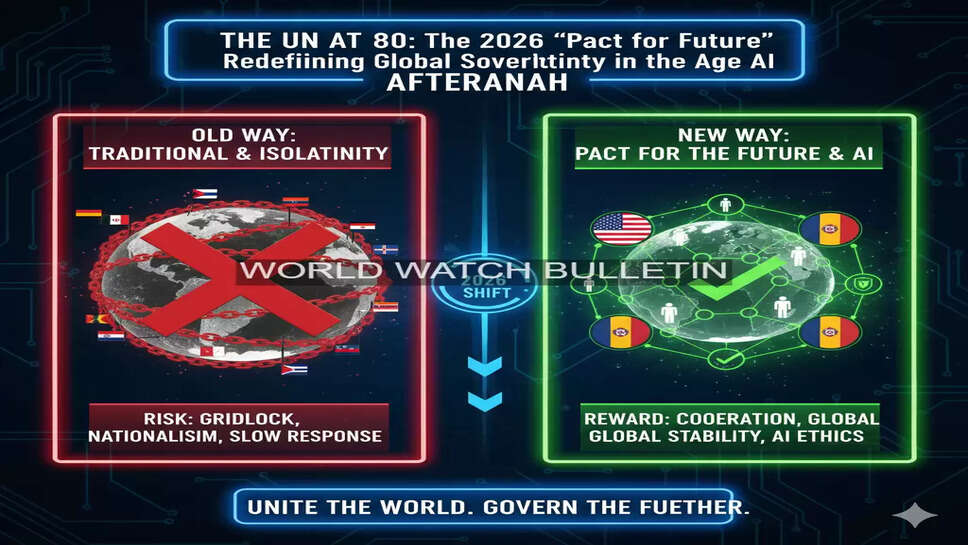
In January 2026, the United Nations Headquarters in New York stands as the focal point for a new world order. Eighty years after the signing of the UN Charter, the definition of a "sovereign state" has expanded. It is no longer enough for a nation to control its borders and currency; in 2026, sovereignty is defined by compute, data, and algorithmic agency. The Pact for the Future—and its critical annex, the Global Digital Compact (GDC)—has entered its primary execution phase, moving from high-level rhetoric to a concrete framework for Sovereign AI. As AI agents begin to manage national power grids, healthcare systems, and judicial processes, the UN has stepped in to prevent a "bipolar AI world," advocating for a future where every nation has the right to build and control its own "Sovereign Intelligence" stack.
The 2026 Implementation: From Pact to Practice
The Pact for the Future is built on five core chapters, but in 2026, the focus has narrowed to Chapter 3: Science, Technology, and Innovation. The UN's mission this year is to ensure that AI does not become a tool for "Digital Enclosure" by a handful of corporations or superpowers.
-
The International Scientific Panel on AI: Launched officially in late 2025, this panel (often compared to the IPCC for climate) is now issuing its first "State of the AI" reports. These reports provide the scientific basis for the Global Dialogue on AI Governance, helping nations understand the cross-border risks of autonomous agents.
-
The Sovereign AI Fund: A key 2026 initiative is the $3 Billion Global AI Fund, designed to help developing nations secure "irreducible minimum capacity"—the basic compute and data infrastructure needed to run localized AI models without relying on external cloud providers.
-
Digital Public Infrastructure (DPI): The UN is promoting "Sovereign AI" as a public good. In 2026, dozens of countries are deploying UN-sanctioned open-source AI stacks to manage everything from agricultural yields to pandemic response, ensuring that the "brain" of the state remains under local control.
Redefining Sovereignty: The "Right to Compute"
The 2026 UNGA is seeing the emergence of a new legal concept: The Right to Computational Sovereignty. Small and middle-power nations are arguing that if a country does not own its AI models, it does not truly own its future.
[Image: A "Global Sovereignty Map" for 2026. Instead of traditional borders, the map shows "Compute Zones" and "Data Residency Hubs." The legend explains how the UN Pact for the Future protects these zones from "Algorithmic Interference."]
This shift is creating a "Non-Aligned Movement" for the digital age. Countries are banding together to build Regional AI Collectives, sharing GPUs and datasets to compete with the sheer scale of the U.S. and Chinese tech ecosystems. The UN at 80 acts as the "Neutral Switchboard" for these collectives, ensuring that regional AI models remain interoperable and adhere to the Global Digital Compact’s safety standards.
Challenges at 80: The Fragmentation Risk
Despite the optimism of the Pact for the Future, the UN at 80 faces existential threats. The "Digital Divide" is wider than ever, and 2025 was a "profoundly challenging year" for international cooperation.
-
Algorithmic Warfare: The UN is currently debating a "New Agenda for Peace" to address the use of AI in autonomous weapons systems (LAWS), which many fear could undermine the very principle of human-led sovereignty.
-
Sovereign Debt vs. Sovereign AI: Many Global South nations are caught in a trap: they must choose between paying off massive sovereign debts or investing in the AI infrastructure required to stay competitive in 2026. The UN’s SDG Stimulus is attempting to bridge this gap, but the tension remains high.
Conclusion
As the UN marks its 80th year, the Pact for the Future serves as a vital update to the original 1945 mission. In the age of Sovereign AI, peace and security are no longer just about preventing physical war; they are about preventing "Algorithmic Subjugation." By championing the right of every nation to develop its own intelligent infrastructure, the UN is attempting to ensure that the next 80 years are defined by collective progress rather than technological hegemony.
FAQs
What is the UN "Pact for the Future"? It is a comprehensive international agreement adopted in 2024 (and implemented through 2026) aimed at reforming global governance to handle 21st-century challenges like AI, climate change, and outer space security.
What does "Sovereign AI" mean in a UN context? It refers to a nation's ability to develop, own, and govern its AI systems (including hardware, software, and data) to ensure national security and economic independence.
What is the Global Digital Compact (GDC)? The GDC is an annex to the Pact for the Future that sets out shared principles for an open, free, and secure digital future, focusing on closing the digital divide and establishing AI safety standards.
How is the UN celebrating its 80th anniversary? The UN is hosting a series of high-level meetings in 2026 focusing on "renewed multilateralism," including a major summit on the "A Living Legacy" of the UN Charter and the official launch of the Global Fund for AI.
Can the UN actually regulate AI? The UN doesn't "regulate" AI in the sense of passing laws, but it sets the "Global Norms" and ethical frameworks that most nations use as the basis for their own domestic AI legislation.